El Pescador Resort - Belize El Pescador

  • About Belize
  • Our Resort
  • Vacation Packages
  • Belize Fishing
  • Belize Diving
  • ECO Adventures
  • Gallery
 
Home » Belize Fishing » Fishing Articles » Silver Kings of Belize

Silver Kings of Belize

Author: David A. Ross
Published by:Saltwater Fly Fishing Magazine Sat January 29, 2000
Tarpon caught by author

The author hefts a silver king: taken while sight- fishing on the flats off Ambergris Caye in Belize.

Resident schools of moderate-size tarpon roam the flats around Ambergris year round, and the fish eagerly eat flies. The flats of Belize offer top- notch tarpon fishing-- if you can ignore the bonefish and permit.

It was an opportunity too good to refuse: "Come to Belize and sight-fish for tarpon," my contact said, I had tried fly fishing for tarpon in Costa Rica, Florida, and the Bahamas, but the results were always the same- little luck, since I forever seemed to be fishing at the wrong time. So when I asked, "When is the best time to sight-fish for tarpon in Belize?" the answer from my Belizean contact was surprising: "Anytime!"

Map of Belize

I found out that resident schools of moderate- size tarpon (fish 20 to 100 pounds) roaming the broad flats near Ambergris Caye will take a fly any time of the year. If you are interested in catching even larger silver kings, some begin migrating through the area in March and stay around until midsummer.

After a great year of striper fishing in New England I was anxious, in the fall of 1998, to get to Belize. But in October, Hurricane Mitch was positioned just south of the small island nation in the Yucatan, pounding Honduras and Guatemala. Although Belize itself was spared the damaging effects of the storm, I decided to postpone my trip until early January.

Belize is a small country on the Caribbean Sea located between Mexico to the north and Guatemala to the south. It possesses less than 9,000 square miles, about the size of Vermont, and has a population of slightly more than 200,000. The world's second-longest barrier reef, about 185 miles long, extends along its coast; the reef is renowned for its superb diving and good fishing.

Fly patterns for Belize tarpon

Cockroach patterns with orange grizzly hackles are top flies for the silver kinds of Belize.

The country has an interesting history. The original inhabitants were Mayan Indians, most of whom later migrated to Mexico. Unlike much of Central America, the territory was not conquered by Spanish conquistadors, but rather was settled by shipwrecked British sailors in 1638. Belize became a British colony in the 1860s and was known as British Honduras until early 1981, at which time it became an independent nation. It is a stable and democratic country and is unique in Central America in that English, rather than Spanish, is the common language.

Author with jack crevalle fish

Jacks are plentiful in the waters off Ambergris Caye, and offer great sport for anglers using 8-weight outfits.

Although it is a small country, there are many things in Belize for the visitor to experience: Mayan archeological ruins, rain forests, reef diving, bird-watching, and fly fishing. In addition to the many crystal clear bonefish and tarpon flats, there are also numerous rivers and brackish estuaries, and, of course, the reef There is an impressive variety of fish to be caught in Belizean waters.

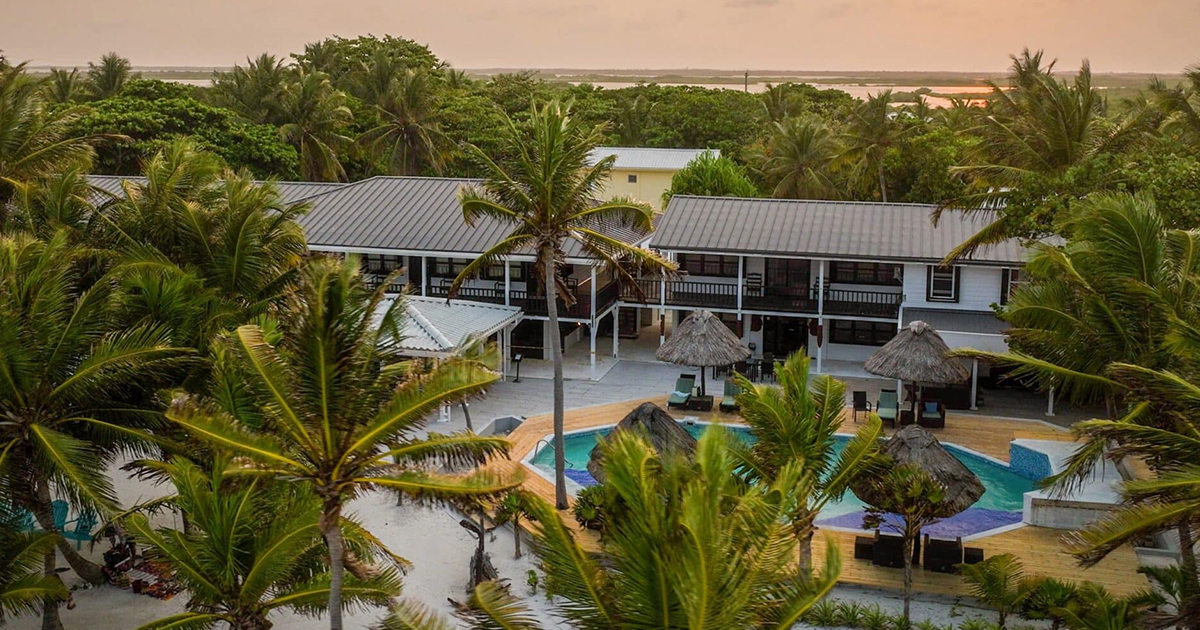
My good friend Dr. David Duane, who had recently retired from the National Oceanic and Atmospheric Administration, joined me on my January journey to the island. Dave had just started to fly fish and he enthusiastically agreed to help with the photography. We fished out of El Pescador Lodge on Ambergris Caye, the largest of the many reef islands off Belize, about 24 miles long. (Ambergris was originally connected to Mexico, but a channel was dug at its northern end by the Mayans in the 7th century A.D. to give them access to the. quiet waters of the lagoon between the island and the mainland.)

Ambergris Caye has a population of about 4,000 people, most of whom are employed in some aspect of the tourist business and live in the town of San Pedro. The island is about one-third of a mile from the offshore reef, and on most days we could hear and see the waves breaking on the reef edge as we stood on shore. (The reef absorbed much of the damaging swell from Hurricane Mitch and thus protected the coastal region of Belize.)

At the lodge, we had four fishing options: bonefishing along the numerous tidal flats and mangrove marshes; catching a wide variety of fish on the reef; targeting permit, jack crevalle, possibly snook, and other species in the tidal channels between the mangrove islands; or sight-fishing for tarpon on the flats. We did all except the reef fishing, but we really focused on tarpon.

Magazine cover

Cover of the Saltwater Fly Fishing Magazine Dec/99 Issue

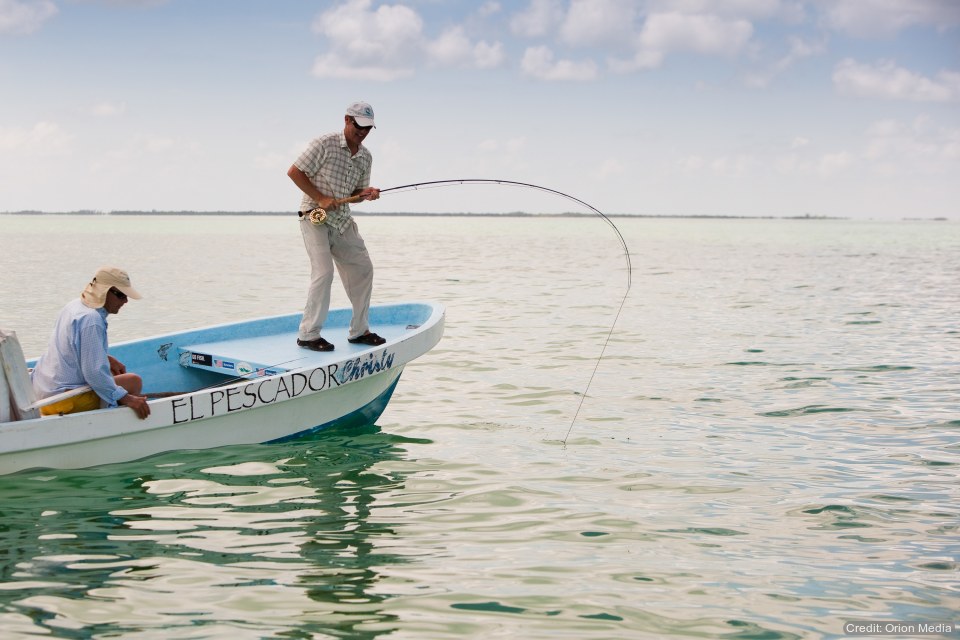
We fished out of a 21-foot skiff, commonly called a panga. The boat was very stable, dry, and easy to fish from. I brought a stripping basket but did not need it, as there was adequate room to place my line on the deck and keep it out of trouble. Our guide, Nesto Gomez, was friendly, efficient, and had a remarkable set of eyes. He did not hesitate to chase tarpon once he sighted them, so I often had multiple chances to cast to the same pod of fish. Nesto was also an excellent caster and gave good advice. (He provided the tarpon leaders, but I brought along the flies.)

Bonefishing in Belize waters varies from one area to another. in the Ambergris Caye region, it is mainly done from a boat, as the bottom is often too soft for wading. The bonefish tend to be in the 2- to 4-pound range, and Dave and I caught several of these fellows, mainly on Crazy Charlies or brown Puffs. We also saw some larger bones.

Jack crevalle and other jacks are common in many of the cuts between small mangrove islands. These are wonderful species for fly fishers, and when I return to Belize I plan to spend more time fishing for them. I'm surprised that more fly fishermen don't target jack crevalles. Small ones, in the 4- to 5-pound range, gave me all I could handle on an 8-weight rod. I did very well using a typical striped-bass fly, a chartreuse-and-white Half-and-Half (half Deceiver, half Clouser Minnow). Nesto was startled when I pulled out this fly, as it was about three times the size of what he normally uses, but the fish loved it. Unfortunately, I had only two of these along; one was chewed up and the other was eventually chewed off.

On two outings, we saw small schools of permit. I had more than one chance at a flats slam (bonefish, tarpon, and permit caught in one day), but the permit did not accommodate me, even when I used crab flies.

We sight-fished for tarpon on the Savannah, Congerejo, and Blackadore flats between the mainland and Ambergris Caye, only about 20 minutes from the lodge. The water was clear and shallow, usually about five feet deep or less. it was fairly easy to see the tarpon through polarized sunglasses. Often groups of four or more tarpon, weighing 50 pounds or more, would slowly approach our boat, sometimes even going under it. We easily saw more than 100 tarpon each day. When casting to them you want to get the fly fairly close; it took me a while to appreciate that tarpon are not easily spooked.

I used a 10-weight rod, initially with a 10-weight intermediate shooting head and braided running fine. This was a mistake for two reasons. First, a floating fine provided a better presentation and kept the fly within the tarpon's feeding area. Second, Nesto wondered how I could hold onto the braided line and set the hook without badly cutting a finger. I quickly changed to a full length floating line.

To my surprise I hooked the first tarpon I cast to, about a 60-pounder. It was very dose to the boat and its first jump, about 30 feet away, was startling. its second jump, about two seconds later, was about 20 feet away, and with the third jump, about 10 feet away, it threw the hook.

I had several good shots at tarpon in the following days, often requiring relatively short casts. The fish were most responsive to flies that were similar in color to the bottom; Cockroaches and flies with orange grizzly hackles were especially successful. Getting a follow or a take was one thing, but the real challenge was getting the fish to the boat. I only landed one silver king, and it was an experience that I will never forget. The fish was never out of my sight and I had to keep it away from several sharks that were attracted by its thrashing. After a few pictures we made sure the fish was revived, and let it go.

If I had to summarize my Belize experience in one word, it would be "easy." There simply was no pressure, the fishing was excellent, the variety great, and we rarely saw another boat. Whatever the direction of the wind, there was always a calm place to fish. The food at El Pescador was superb, the guides couldn't have worked harder, the rooms are comfortable and clean, the staff was friendly and helpful, and transportation was convenient. I can't wait to go back.

David A. Ross is an oceanographer who lives on Cape Cod He writes the column 'Marine Science For Fly Fishers "for this magazine. David Duane is a marine geologist who previously was the national director of the Sea Grant Program within the National Oceanic and Atmospheric Administration.

Belize Fly Fishing Vacation Offer
  • Home
  • Bonefish Island
  • Fishing Reports
  • Fishing Calendar
  • Our Fishing Host
  • Fishing Guides
  • Fishing Rates/Package
  • Fishing Articles
  • Fly Patterns
  • Fishing Tips
  • Fishing Gear
  • Photo Gallery
  • Photo of the Week
contact the resort
Orvis Endorsed International Destination
  • El Pescador Resort
Belize Video
Orvis Endorsed International Destination
Green Initiatives
© Copyright 1974-2012 El Pescador Resort on Ambergris Caye Belize
Serving Belize vacation travelers since 1974 Privacy / Terms | Contact Us
Web Design by Selser Media